Heart failure drives hundreds of billions in annual global healthcare costs
The cost reflects a lack of precision targeted therapies that intervene before irreversible damage.
CorSilico builds personalized heart digital twins from a standard blood draw. Our foundation model maps circulating cell-free RNA and DNA back to the source cells driving injury.
Recognized science. Exceptional pedigree.
 Katz AwardAmerican Heart AssociationInnovative Project AwardAmerican Heart Association
 Top 15 ventureCure MEHA II

The cost reflects a lack of precision targeted therapies that intervene before irreversible damage.
Diverse comorbidities create different populations of invasive cells that cause damage in each patient.
Ultrasound and MRI detect historical damage after irreversible scarring has occurred. The cellular drivers remain hidden.
Recent high-profile clinical trial failures show that broad targeting of disease-causing and protective cells leads to clinical failure.
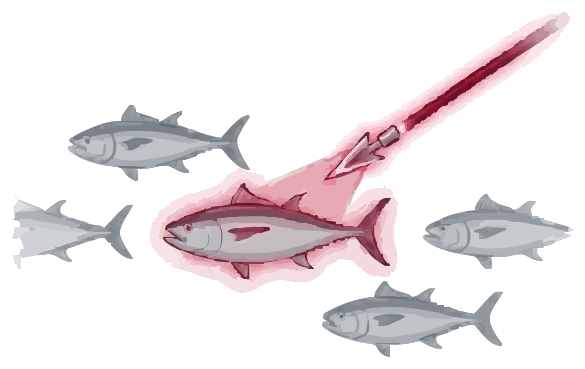
Without precisely targeting the damage-causing cell subsets, multi-million-dollar assets cannot match the right patient to the right drug at the correct time.

Our preclinical work discovered the cell subpopulations damaging the heart and mapped their spatial microenvironments. This spatial arrangement dictates disease trajectory and therapy response.
 Published in

A foundation model trained on paired blood and heart tissue to map circulating cell-free RNA & DNA back to their source cells in the injured heart.
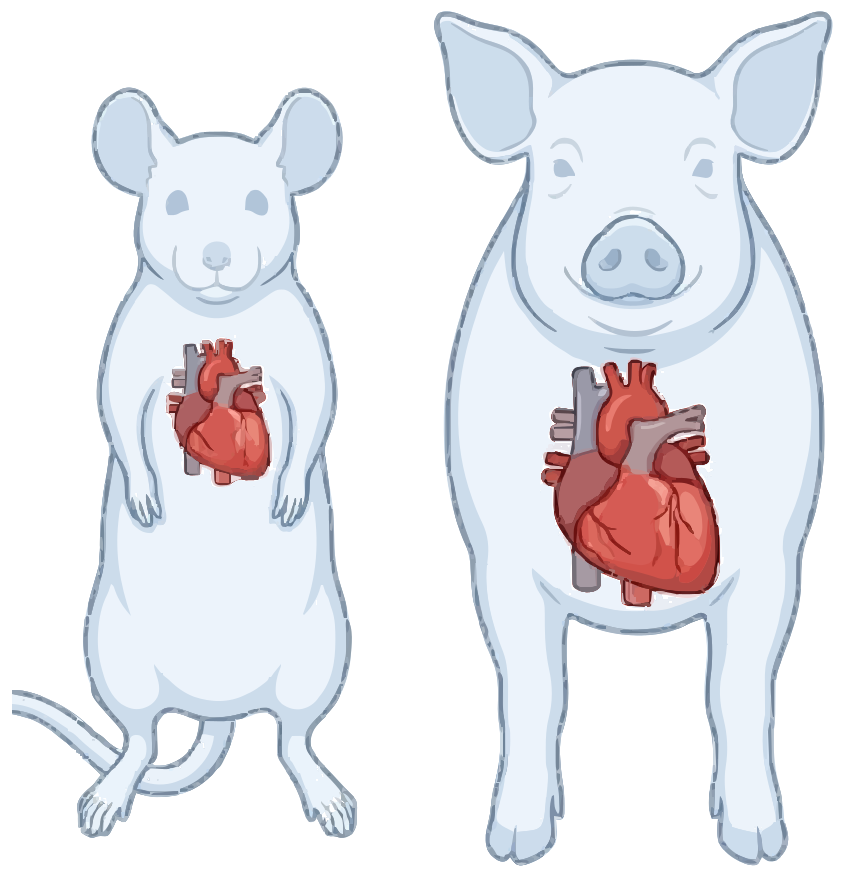
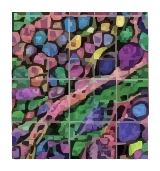
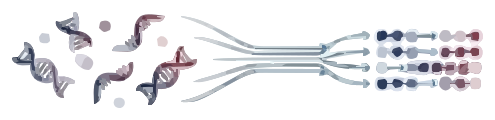
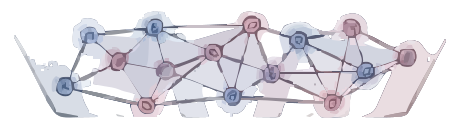
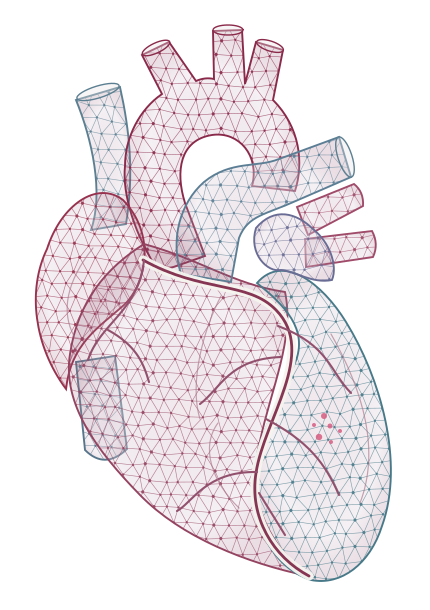
The trained foundation model is used to create patient digital twins.
The model projects human liquid biopsy into a spatial latent space, generating personalized digital twins of the living heart.
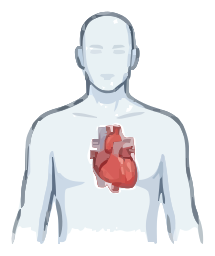
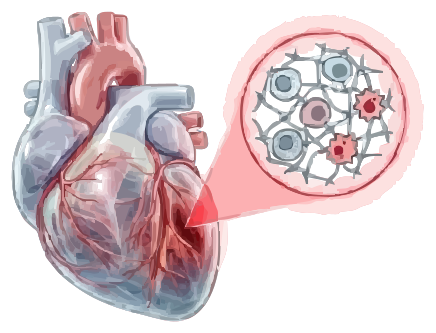
Identify real-time hidden pathology, before damage happens.
The world’s first and largest data engine of human heart failure cell niches, longitudinally resolved to disease progression. A by-product of creating thousands of human heart failure digital twins.
06 / Commercialization
Commercialization begins with retrospective patient stratification for stalled heart-failure trials, followed by clinical theranostics licensing and therapeutic IP out-licensing.
Near-term serviceable revenue from retrospectively stratifying just 5–10 stalled heart-failure trials. Identify the patients most likely to respond to targeted assets.
Annual recurring revenue opportunity at a $15,000 diagnostic price, reaching 0.1%–0.5% of 13.2M+ eligible US patients. Preventing a 30-day readmission exceeding $27K per event underpins the value proposition.
Big Pharma partnerships shift clinical-trial execution to the partner. Precedent precision-therapy deals: $160M–$185M upfront, up to $4B+ in staggered pre-commercial milestones, and 12%–17% tiered royalties.
Company opportunity estimates and development strategy; figures are projections, not realized revenue. Precedent deal terms do not predict future agreements.
07 / Why now
A multi-hundred-sample foundation AI model became economically possible for the first time.
Commercial platforms can cost up to $5,000 per tissue cross section. Our in-house spatial transcriptomics platform is designed to deliver high-definition tissue profiles at 15% of commercial cost—unlocking the scale a foundation model needs.
Proprietary in-house spatial transcriptomics, the heart-failure foundation model, and a deconvolution pipeline designed to capture unstable, low-abundance circulating fragments.
Every new digital twin improves the model. More paired data enables better mapping, attracting more partners and patients—and generating more data.
Proprietary architectures, training data, and deconvolution pipelines. Years of wet-lab R&D and tissue-handling expertise encode knowledge that cannot be copied from a dataset.
09 / The market
TAM / DIAGNOSED US MARKET
Company-estimated accessible market, based on conservative 30% access to 6.7M diagnosed US heart-failure patients and a $15,000 platform baseline cost.
SAM / PROSPECTIVE PRE-HF MARKET
The top 10% highest-risk individuals within the Stage B pre-heart-failure population, targeted for prophylactic screening.
SOM / NEAR-TERM EXPONENTIAL CAPTURE
$75M–$150M in companion diagnostics. $213M–$1.06B+ in clinical theranostics ARR. Therapeutic IP with precedent upfront payments of $160M–$185M and up to $4B+ in milestones.
Company market estimates reproduced from the source materials. Figures are approximate and reflect separate addressable populations and commercialization assumptions.
10 / Roadmap & financing
Porcine heart-failure cohort 1 and spatial-to-liquid deconvolution.
Key hires, BSL-2 lab, compute, and spatial-omics infrastructure.
Early-access biopharma business development, provisional patent filings, and core operations.
Establish the BSL-2 lab, validate the spatial platform, and launch porcine cohort 1.
Pair tissue maps with circulating signals; complete the first ground-truth cohort.
Biopharma data agreements, trial-rescue pilots, and human digital-twin translation.
14-MONTH TARGET
Revenue from early-access biopharma partnerships is intended to fund further model development and cohort expansion.
Planned milestones and cash-flow timing are forward-looking targets.